Gremlins 2: Bat Gremlin Movie Prop
The hero “flying” Bat Gremlin is one of the largest and most technically ambitious creations from Gremlins 2, a full-scale puppet created to bring the film’s airborne terror to life through a seamless blend of mechanical engineering, puppetry, and cinematic illusion.
THE GREMLINS MUSEUM

Telemetric Bat Gremlin Movie Prop
Screen Used Flying puppet as seen in Gremlins 2: The new Batch
Introduction
Some of the most imaginative Gremlin transformations in Gremlins 2: The New Batch emerged from the Splice o’ Life laboratory inside the Clamp Center—and few were as memorable as the Bat Gremlin. After drinking an experimental “bat serum,” this gremlin undergoes one of the film’s most striking metamorphoses, sprouting leathery wings and a new reptilian texture that sets him apart from the rest of the horde. Teaming up with the Brain Gremlin to receive an injection of liquid sunblock, he then bursts through a high-rise window in a spectacular sequence that sends him soaring over New York City, leaving chaos in his wake.

The Bat Gremlin’s origins trace back to the early research and development phase at Rick Baker’s Cinovation Studios. Artist Tom Hester was responsible for one of the initial concepts for a generic gremlin, which later evolved into the foundation for the Bat Gremlin’s final form. In early behind-the-scenes photos, Hester can be seen holding one of these prototype sculpts—an early glimpse at the creature’s distinctive silhouette that would eventually take flight as one of the film’s most ambitious and technically complex creations.

The Bat Gremlin is one of the most iconic and technically ambitious creatures in Gremlins 2: The New Batch, realized through an intricate combination of puppetry, animatronics, and visual effects. According to actor Dick Miller, as many as four distinct Bat Gremlin puppets were created for different shots throughout the film, each tailored for a specific range of motion or on-set requirement. Some were designed purely for close-up detail, while others incorporated elaborate wing mechanisms for flight simulation. Throughout this article, we’ll take a closer look at the various styles of Bat Gremlin puppets used in production—including the impressive “flying Bat” version now part of our collection.

On-Screen Transformation
In the Bat Gremlin’s first appearance, a brown Gremlin drinks the experimental bat serum, triggering a dramatic transformation sequence. The scene features a wide full-body shot of a puppet known internally as the “Matt” Gremlin, with blue-screened stop-motion wings unfurling behind him in post-production. This version appears to be a brown pole-arm puppet, engineered to provide a clean, unobstructed view of the full body without exposing elbow rods or puppeteers. To achieve this seamless effect, the production team likely cut a hole into the wall behind the puppet to discreetly route the telemetric control cables—allowing the physical performance and the animated wings to blend convincingly through optical compositing.


The next dramatic reveal presents the Bat Gremlin in full view, showcasing his newly sprouted wings and menacing silhouette. Interestingly, if you compare this shot to the earlier transformation scene, he’s standing in the exact same position as the previous, entirely different-style Gremlin. This continuity strongly suggests that the filmmakers reused the same set setup and cable routing hole in the back wall—repurposing the space to accommodate the upgraded, fully realized Bat Gremlin puppet.

The animatronic Bat Gremlin featured in the laboratory sequence was most likely a pole-arm style puppet, supported by a heavy rod extending from its back and operated by multiple puppeteers stationed behind the gray lab wall. This setup allowed for full-body movement and flight simulation while keeping the performers completely out of frame. The puppet’s facial expressions, eye articulation, and ear movement were controlled through a 1989-era computer system, a hallmark of Rick Baker’s advanced animatronic workflow at Cinovation Studios.

Stop-Motion Sequence
After the Brain Gremlin injects his winged companion with liquid sunblock, the Bat Gremlin prepares to take flight and unleash chaos across New York City. To capture this moment, the production transitioned from practical puppetry to stop-motion animation, as achieving a wide, sustained flight shot with a full-scale puppet would have been nearly impossible on set. The stop-motion work was executed by Doug Beswick’s team of skilled animators—Jim Aupperle, James Belohovek, and Yancy Calzada—and filmed at the Chandler Group facility in Marina del Rey, California. Their work seamlessly blended with the live-action footage, bringing the Bat Gremlin’s aerial escape to life with remarkable fluidity and scale.


The Flying Bat Gremlin Puppet
Once the Bat Gremlin completes his dramatic escape from the laboratory, the stop-motion model transitions seamlessly into the full-scale telemetric “flying” Bat Gremlin puppet—the very piece now housed in our collection. This remarkable build was engineered to capture the sweeping aerial shots of the creature attacking Mr. Futterman, while also providing a tangible, life-sized reference for actors Dick Miller and Jackie Joseph to physically interact with on set.
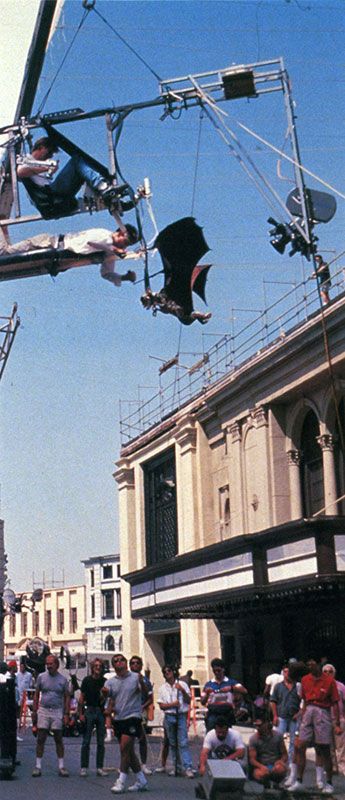
As seen in the following photos, the massive flying rig ranks among the most sophisticated mechanical creations of the entire production—rivaling any of the other animatronic gremlins in complexity. The camera was mounted directly to the front of the rig, while two puppeteers were lifted into the air alongside the puppet to operate its movements and maintain the illusion of sustained flight. This ambitious setup allowed the filmmakers to capture dynamic, in-camera motion that seamlessly blended with the miniature and stop-motion elements.


If you look closely, this flying version of the Bat Gremlin has all of its control mechanisms routed through the ears, which explains why it’s typically filmed from the upper face downward during the attack sequence. Despite that limited camera framing, the puppet was fully functional, capable of moving its feet, flapping its wings, opening and closing its mouth, and even scratching Mr. Futterman’s forehead on cue.

Tim Lawrence on top, Steve Sleap holding the wings, with Joe Dante, Tom Hester, Rick Baker and other various crew on the bottom.
Photos of the Telemetric Bat Gremlin
Shown here are several photos of the surviving Bat Gremlin puppet from our collection—a truly formidable piece that commands an impressive presence in person. Its expansive wingspan and robust mechanical frame make it one of the largest Gremlin puppets ever produced, occupying a significant amount of display space. The previous owner streamlined many of the original puppetry controls to reduce the overall footprint, allowing the puppet to be displayed more cleanly and efficiently while still preserving its intricate internal design. Even decades later, the Bat Gremlin remains a striking testament to the scale, creativity, and technical ambition that defined Rick Baker’s work on Gremlins 2: The New Batch.


