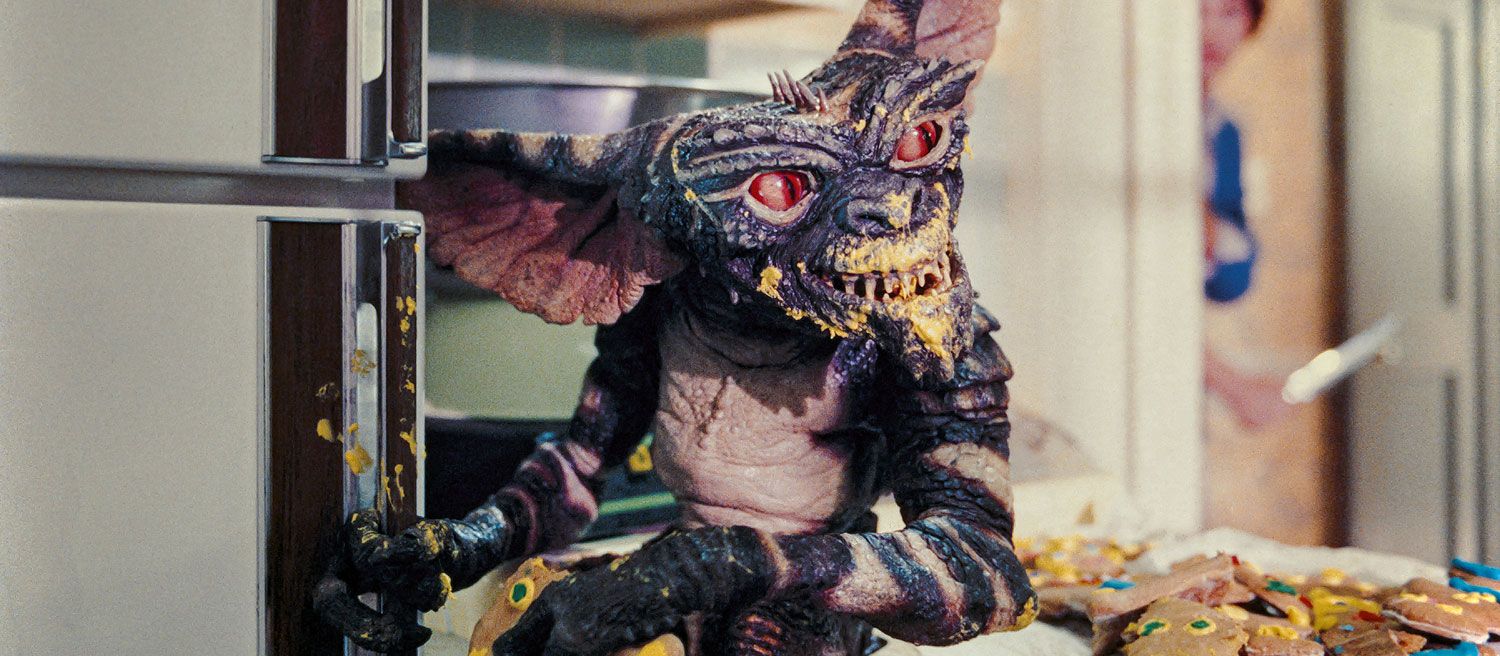
Gremlin in the Microwave
Lynn Peltzer Fights Back:
HOW the Studio Fought to Censor the Most Violent Scene in PG History.
The Scene that Changed Ratings
Joe Dante’s Gremlins (1984) hides a sly subversion of genre beneath its creature-feature shell, blending Spielbergian wonder with bursts of B-movie mischief. Nowhere is that tension more perfectly distilled than in the film’s infamous kitchen sequence—an eruption of domestic chaos that would become one of the most talked-about moments in PG-rated cinema. Midway through the film, the gremlin invasion begins in the Peltzer home, and instead of falling into the familiar “1950s helpless mother” trope, Lynn Peltzer (played with steely resolve by Frances Lee McCain) transforms her kitchen into a battleground. In rapid, darkly comedic succession, she shreds one gremlin in a mixer, stabs another after it hurls plates at her, and finally dispatches a third by blasting it with flea and tick spray before trapping it in the family microwave—culminating in one gloriously explosive payoff.
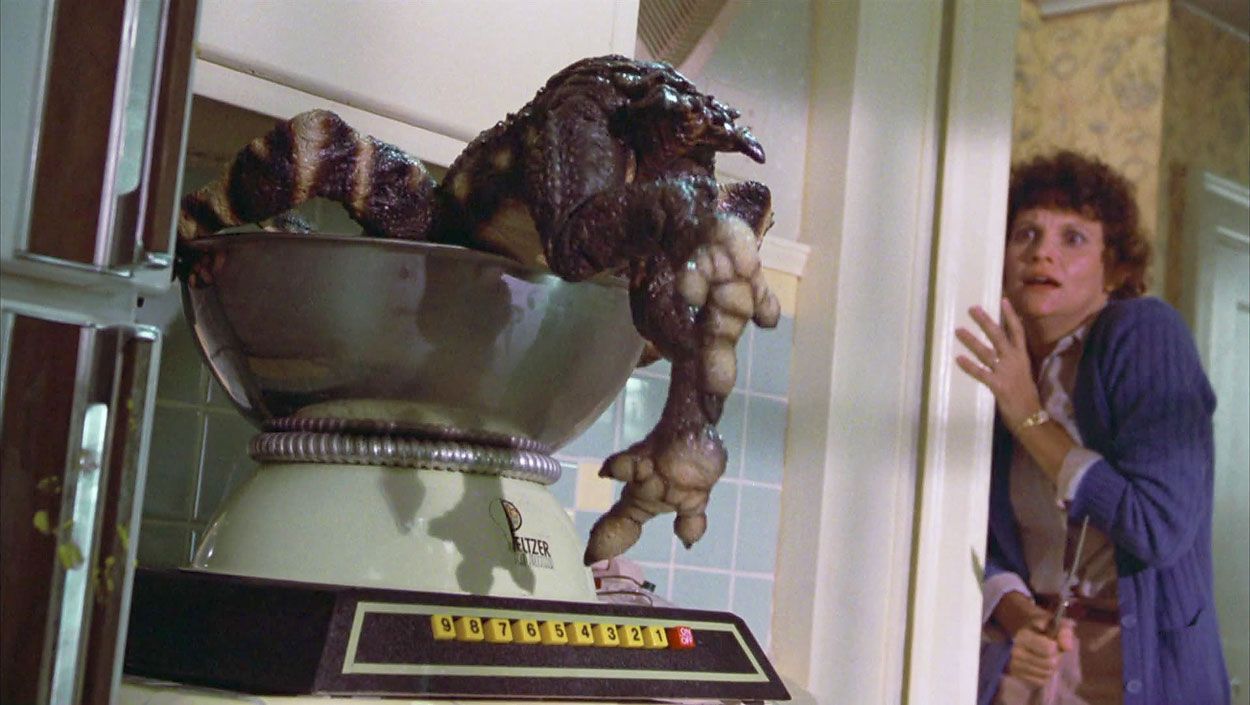
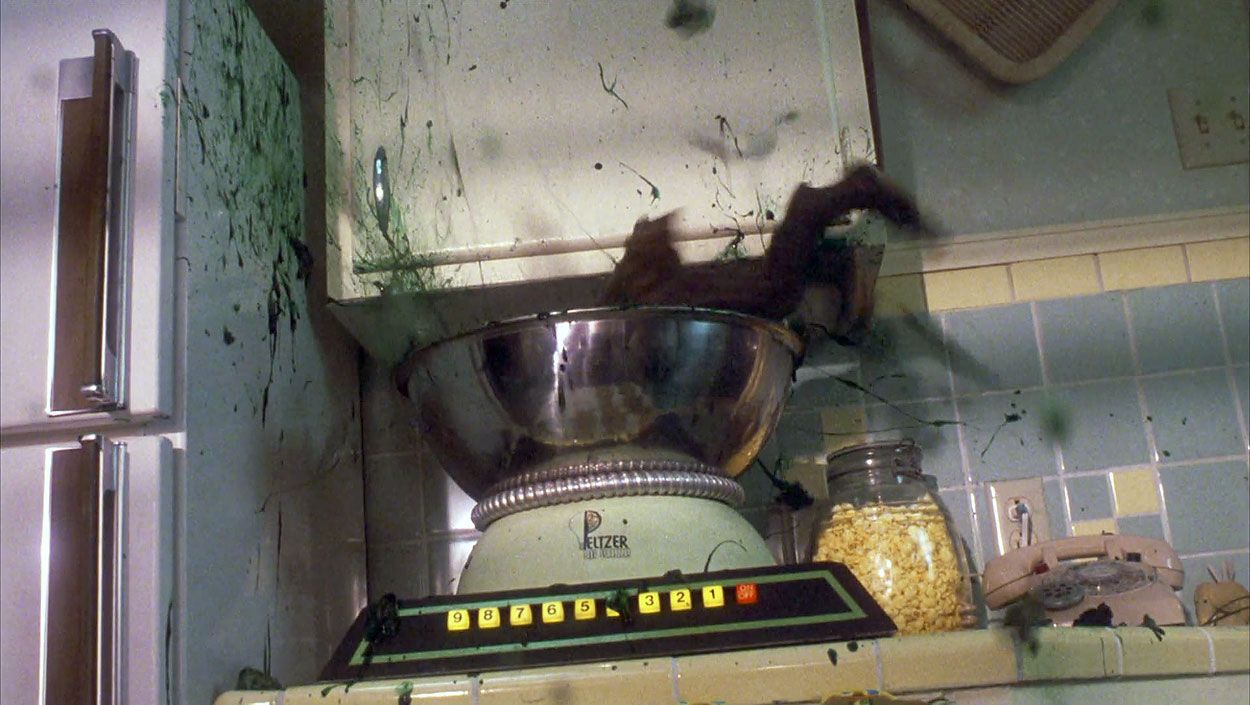
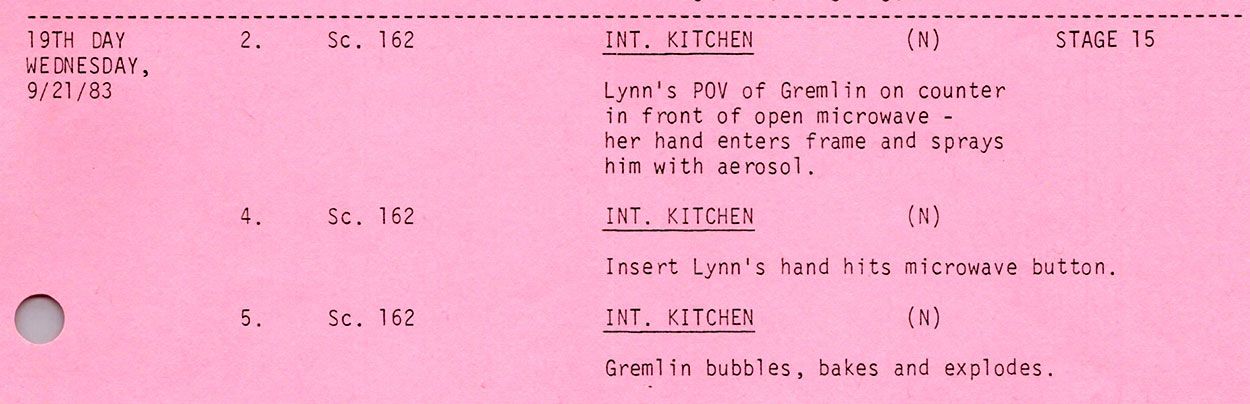
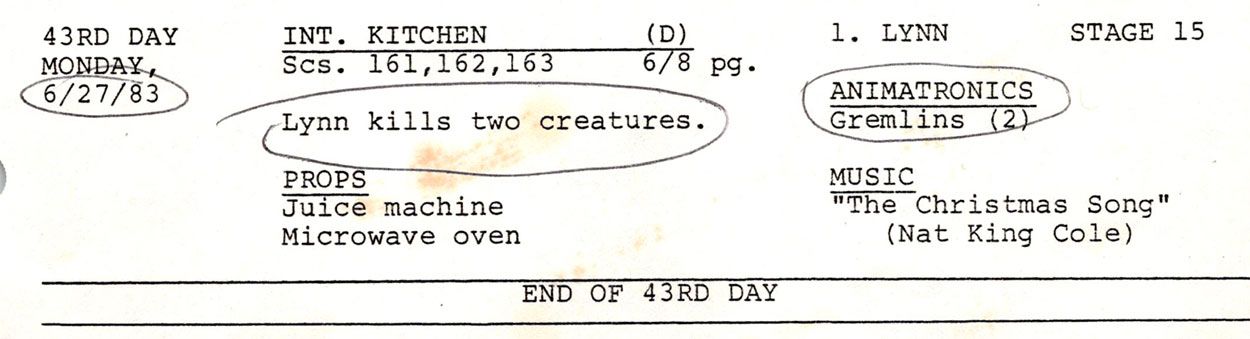
Gremlins post-production shooting schedule detailing the microwave shot
Walking a razor’s edge between slapstick and horror, the scene became a flashpoint in the broader debate over what constituted “family entertainment” in the 1980s. Its mixture of domestic familiarity, cartoon violence, and unexpectedly graphic payoff rattled parents and executives alike, contributing to the eventual creation of the PG-13 rating. Far from a throwaway gag, the microwave scene stands as a defining tonal statement—one that helped reshape how Hollywood navigated the blurry line between fun and frightening.
The Chris Columbus Origin
To fully appreciate the final execution of the microwave scene, it's helpful to first excavate its origins in the original screenplay by Chris Columbus. Written as a speculative sample while Columbus was living in a loft in Manhattan, the script was inspired by the sounds of mice scurrying in the dark—a primal fear of invasion in one's sanctuary. The initial draft was significantly darker than the final film, envisioned as a "grade-B horror movie" that was "really R-rated."
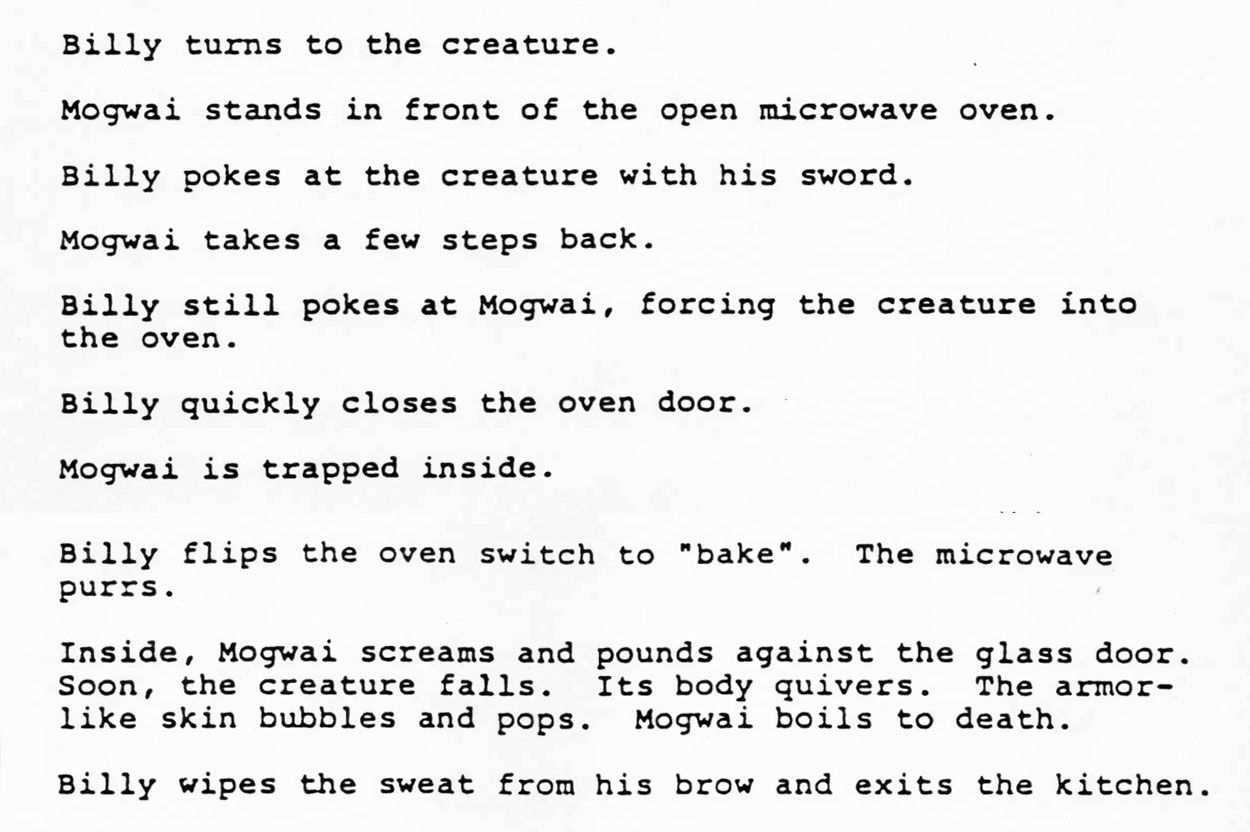
Excerpt from the Gremlins 2nd Draft Script (April 27th, 1982)
In Columbus's Second Draft (dated April 27th, 1982), the kitchen scene plays out very differently. Instead of defending her turf, Lynn investigates noises in the attic, only to be grabbed by the throat and swarmed by creatures demanding "their share of the food." The script describes a truly gruesome demise, noting the sounds of "Chewing. Swallowing. Giggling" as she's dragged into the darkness. When Billy returns home, he finds his mother's lifeless body covered in bites and scratches, and a gremlin throws Lynn's bottle of Valium at him.
In this version, it is actually Billy who enters the kitchen to exact revenge, wielding a sword. The script reads:
"Mogwai stands in front of the open microwave oven. Billy pokes at the creature with his sword... forcing the creature into the oven... Billy flips the oven switch to 'bake'. The microwave purrs... Mogwai boils to death."
Ultimately, sparing Mrs. Peltzer the "grim" fate of the original script was a production masterstroke. By flipping the narrative, the filmmakers subverted the typical victim trope, transforming the "harried homemaker" into a fierce protector who weaponized her own kitchen to deliver the film's most satisfying payback.
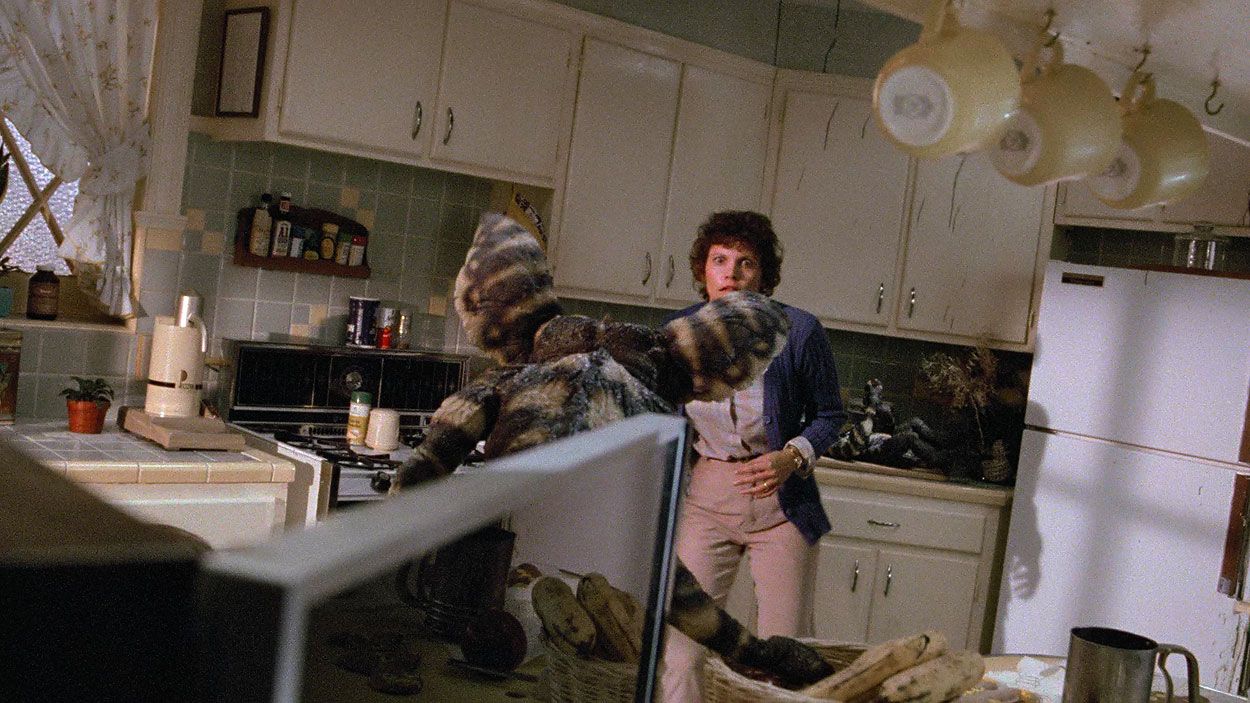
The Three puppets used for the microwave sequence
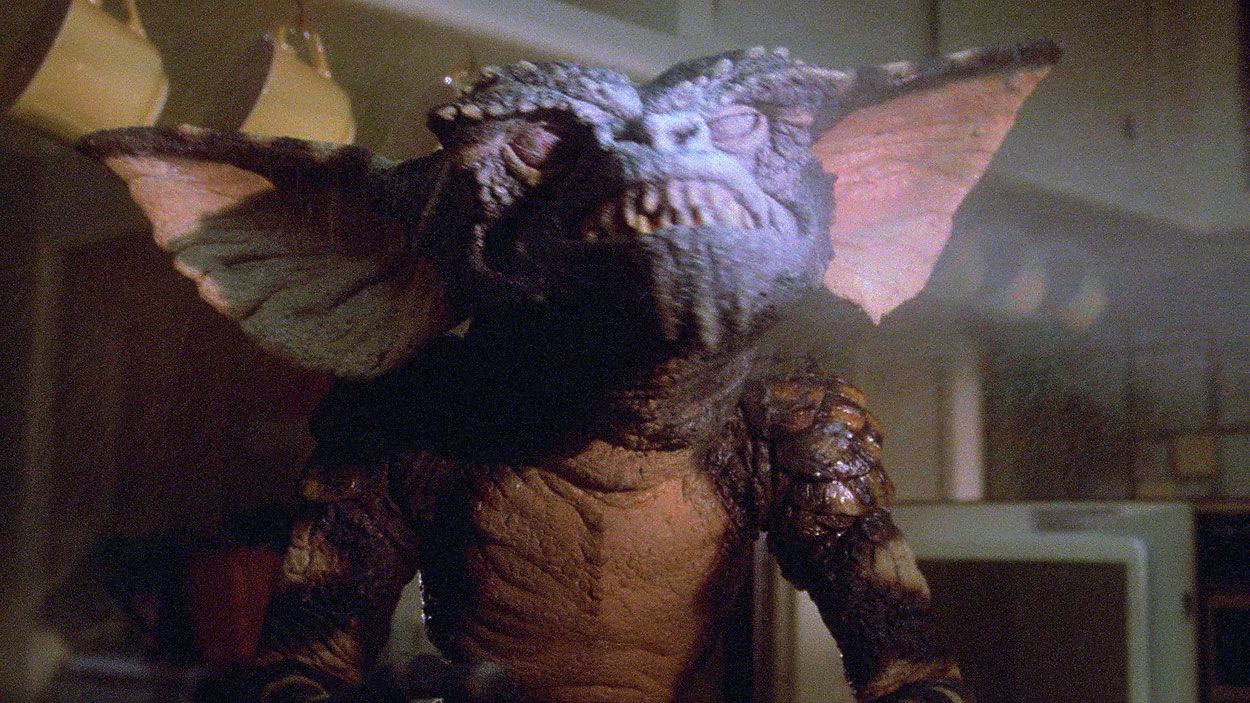
1 - Hand puppet
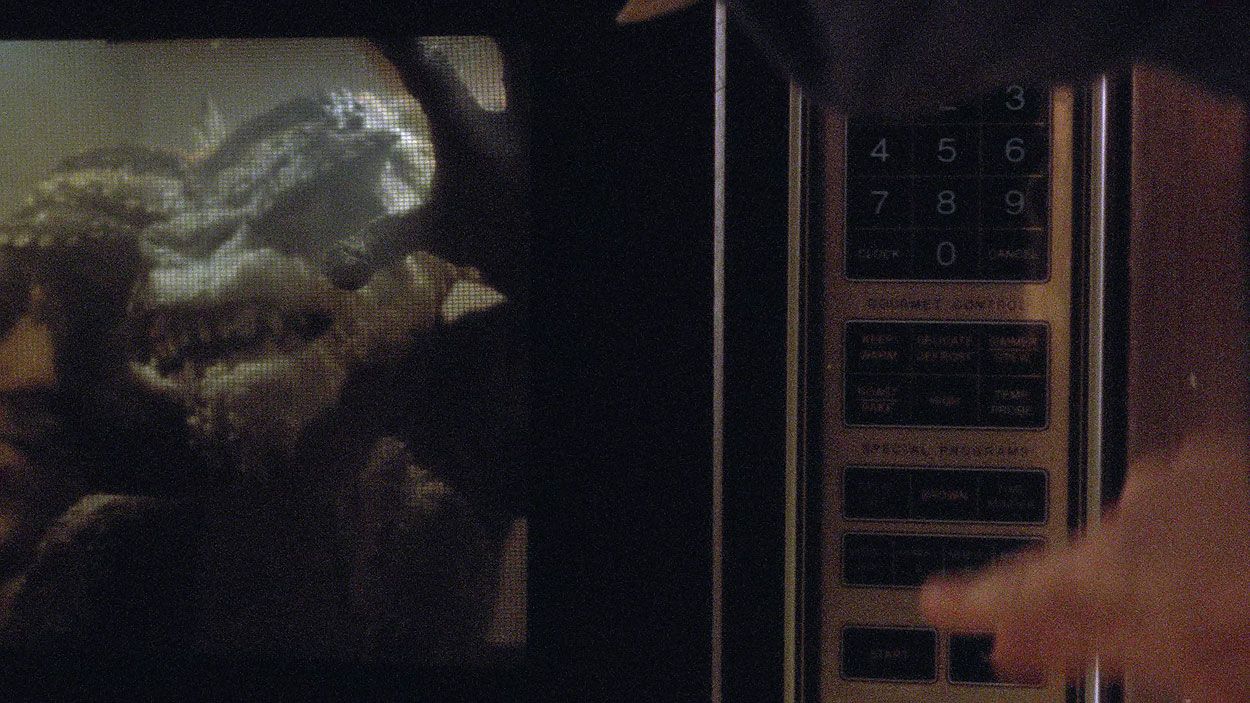
2 - Hand puppet controlled from below microwave
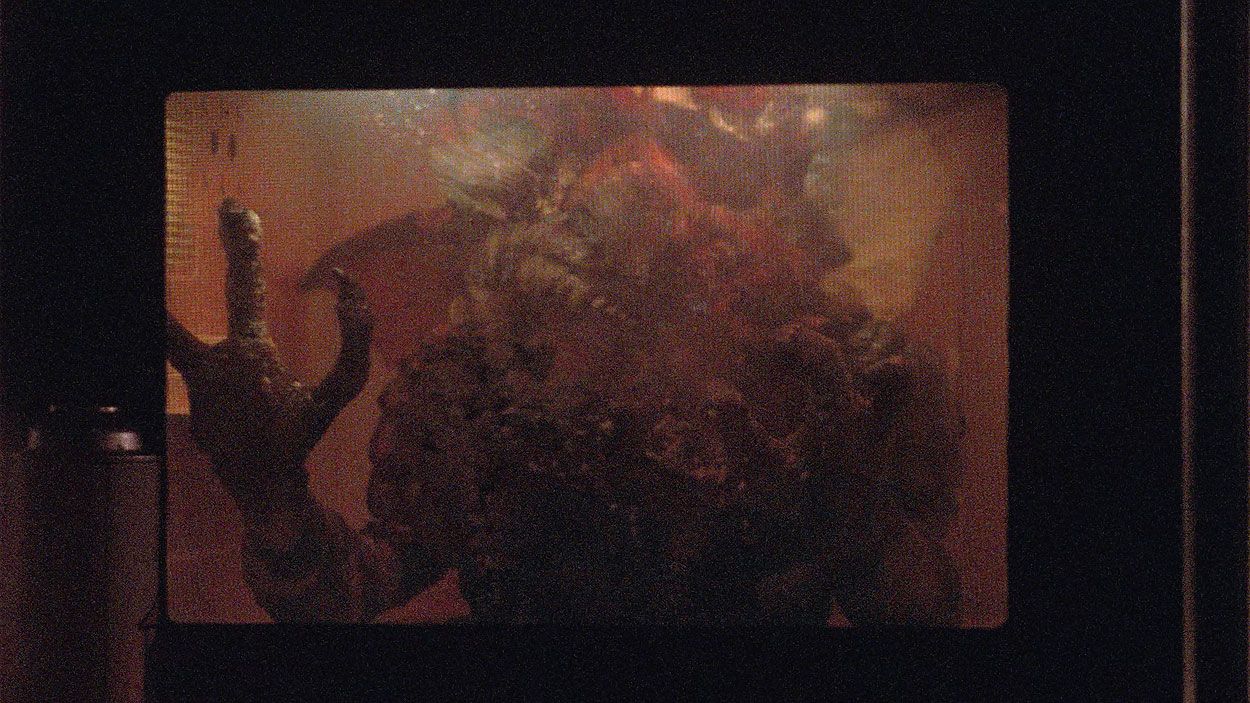
3 - Exploding puppet equip with squibs
Behind the Scenes: The Science Club from Hell
If the microwave shot feels like a chaotic science experiment gone wrong, that’s because, behind the scenes, it essentially was. FX artist Howie Weed described the atmosphere at Chris Walas Inc. best: “Imagine grabbing all the geeks from the High School Drama department and the science club and just setting them loose in a shop.” (Gremlins Museum, December 2025)
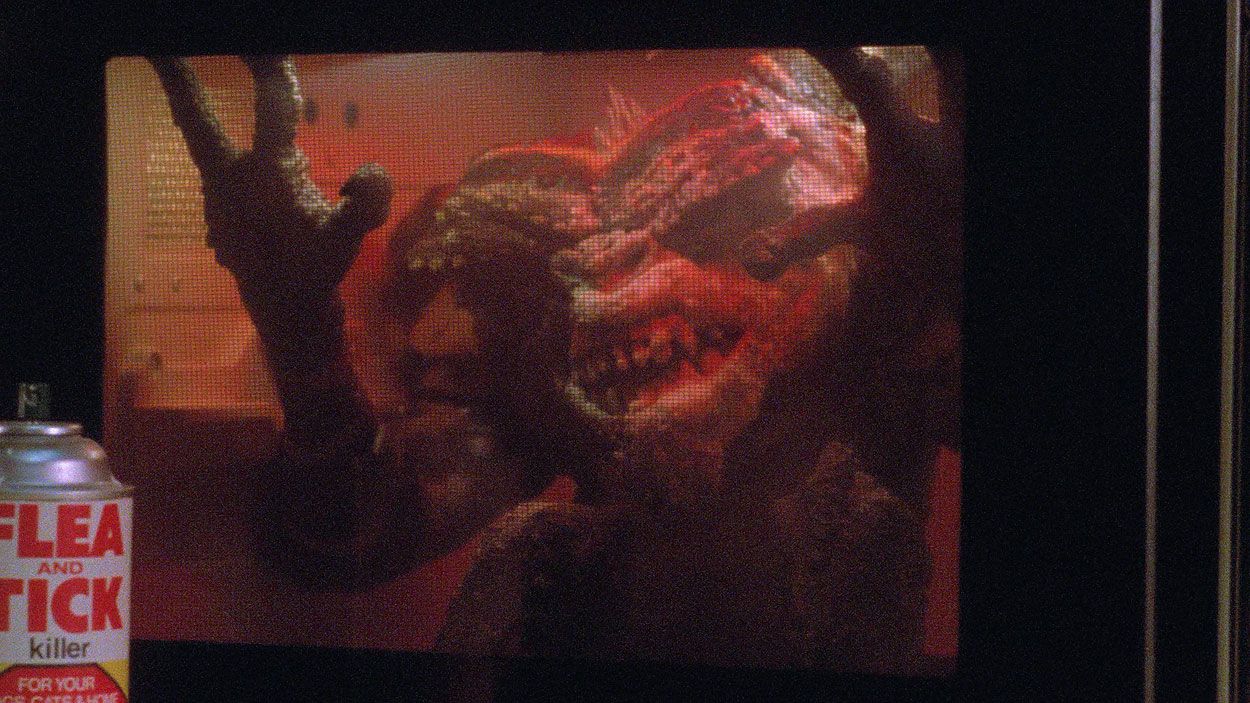
To pull off the infamous microwave explosion, the crew utilized a complex, multi-stage approach involving three distinct puppets. Effects supervisor Bob MacDonald explained the progression: "Three different puppets were used in the microwave. First, Mrs. Peltzer shoves one in. Then a person down below was working a hand puppet up through the bottom of the microwave which was a real oven we had cut out." (Cinefex 19, November 1984)
THE GREMLINS THEATRICAL Microwave scene
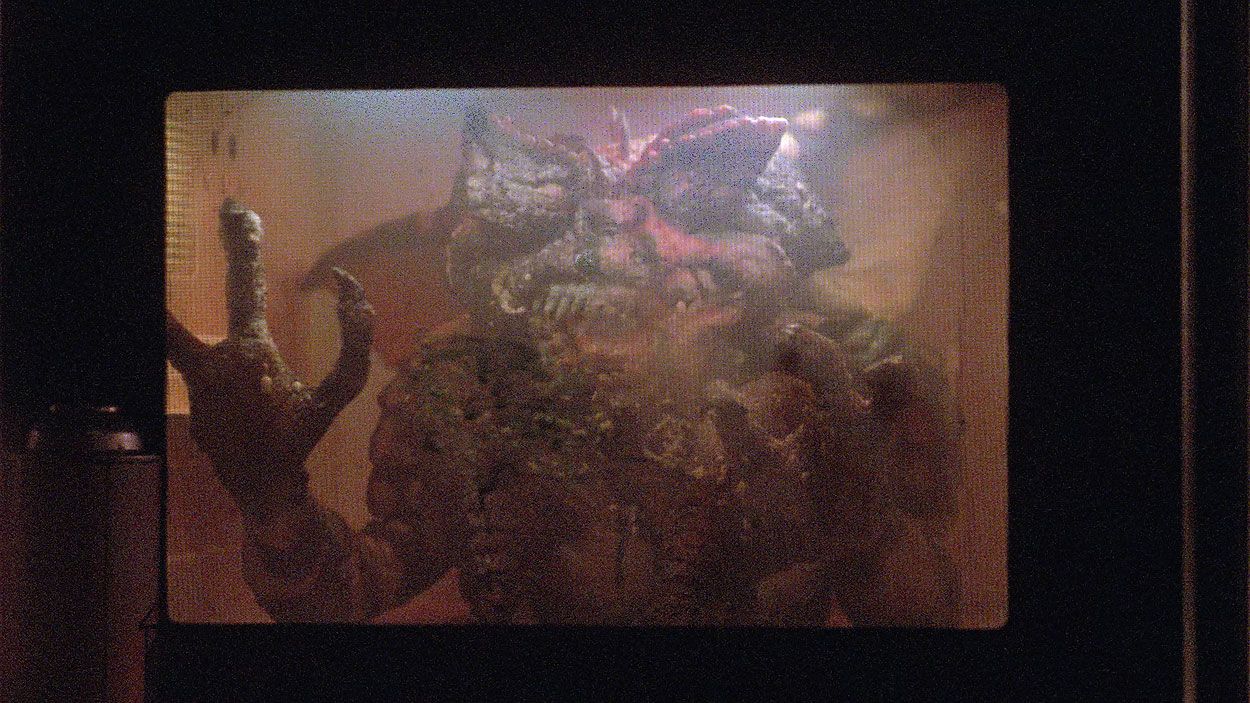
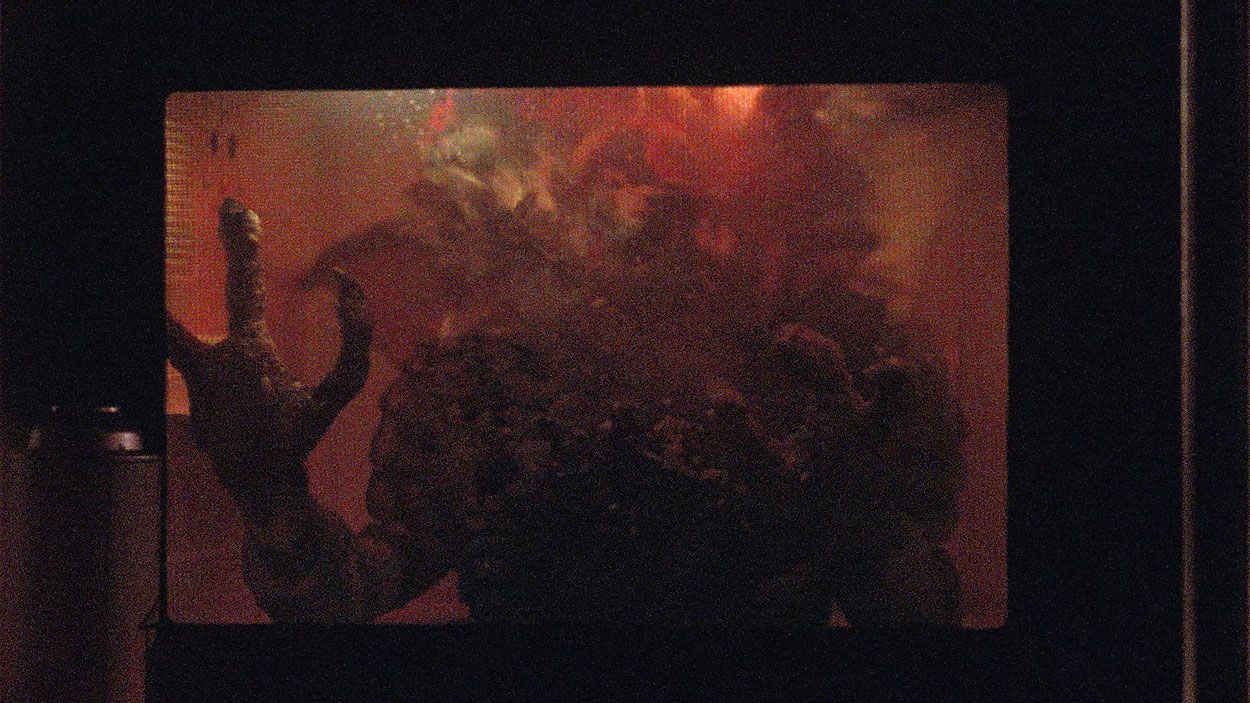
For the spectacular disintegration, they swapped in a third “exploding” puppet. Drawing on his experience blowing apart and melting FX heads in Scanners and Raiders of the Lost Ark, Chris Walas devised the rig for the effect in close consultation with senior special effects supervisor Bob MacDonald, Sr.
Ralph Miller recalls the meticulous (and gloriously messy) setup: “Howie Weed and I cut the microwave gremlin’s face to pieces and stuffed the head with condoms filled with painted bits of foam latex and green tinted Methocel slime.” The special effects team then attached squibs to the condoms and installed a manifold inside the back of the head to blast pressurized air forward. According to Miller, he and Weed “tacked the face pieces back together weakly with spots of rubber cement so it would appear momentarily whole before blowing apart.” (Gremlins Museum, December 2025) The puppet’s body was mounted to a pole that Miller shook violently from beneath the microwave to sell its frantic struggle, and a final squib was mounted on the inside of the oven glass to crack outward at the moment of detonation.
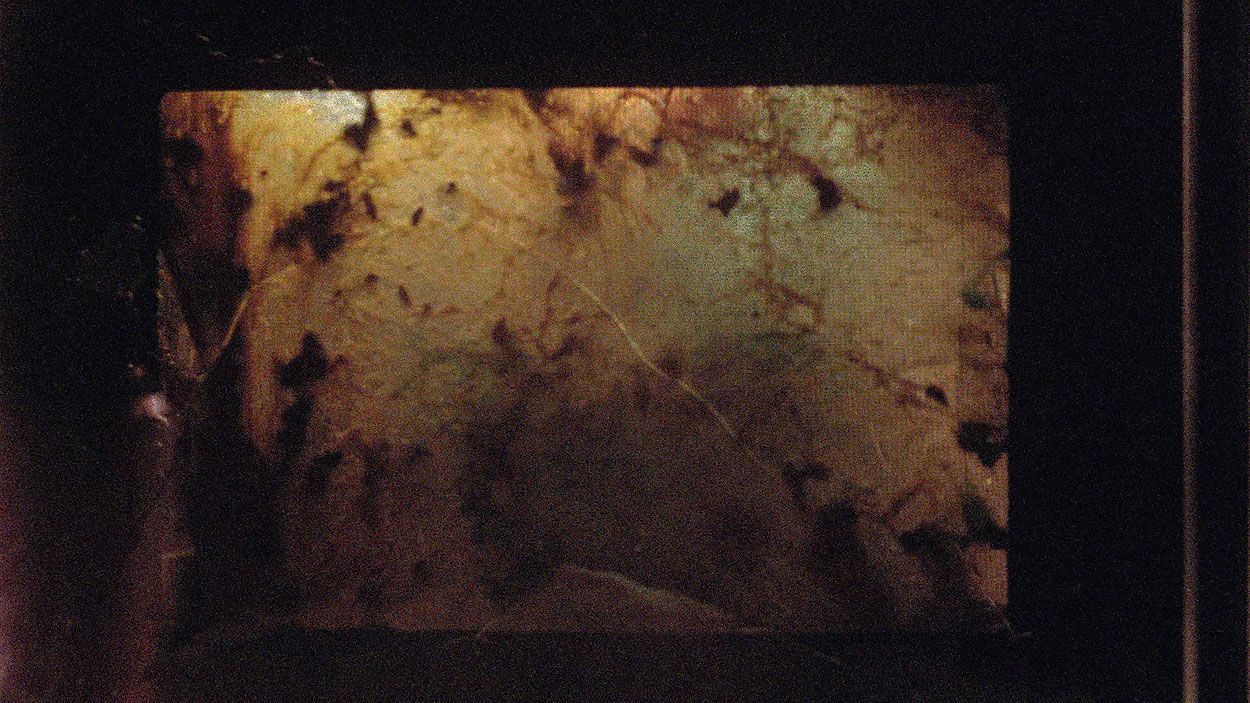
While the explosion was a "crowd pleaser" on set, it left a massive clean-up job in its wake; when the charges blew, the face detonated forward, showering Miller—who was positioned beneath the oven and had wisely been provided a raincoat—in a torrent of goo. Creature designer Chris Walas admits they were astonished the shot made the cut, noting that the version audiences know is actually the restrained take. "People complained about that microwave scene," Walas said, "but they should have seen the take that didn't make it." Walas recalls that the aftermath of the first attempt was "incredibly gruesome," revealing a gremlin with its face blown off and "the top of his head shifting around like a gooey flopping envelope," leaving the glass door completely blown away and "garbage stuck everywhere, all over the oven." (Cinefex 19, November 1984)
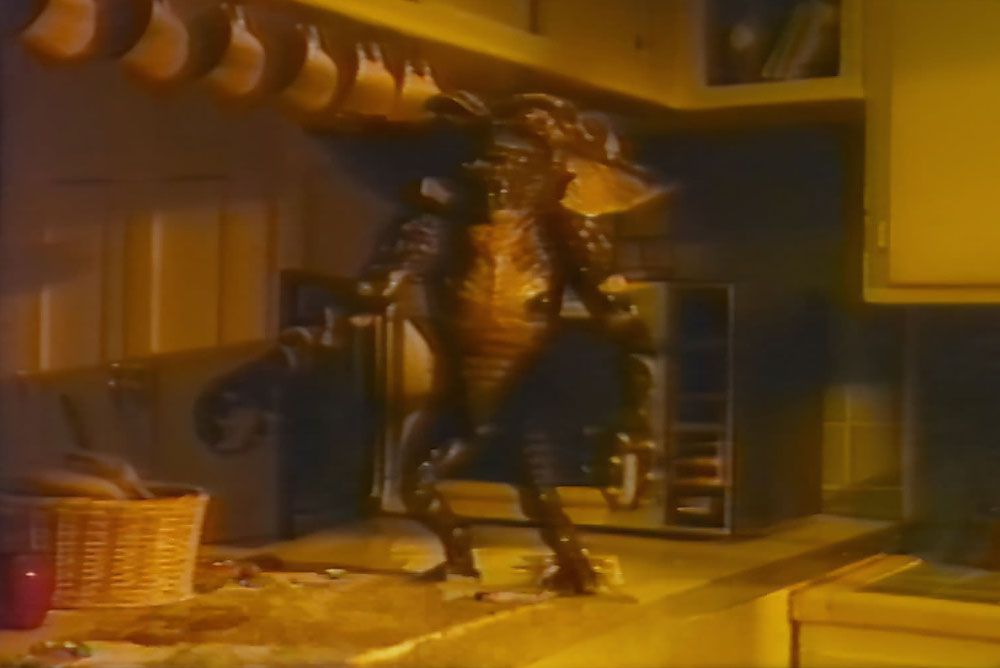
A marionette style Gremlin puppet that appears right as the microwave scene begins.
The Rough Cut Microwave Explosion
In February 2026, the Gremlins Museum acquired the VHS tapes containing Gremlins director Joe Dante’s long-lost rough cut. Buried within the tapes was a treasure trove of expanded scenes, alternate takes, and creative paths that were ultimately abandoned before the film’s theatrical release. One sequence in particular that took on a noticeably harsher tone was the famous kitchen scene.
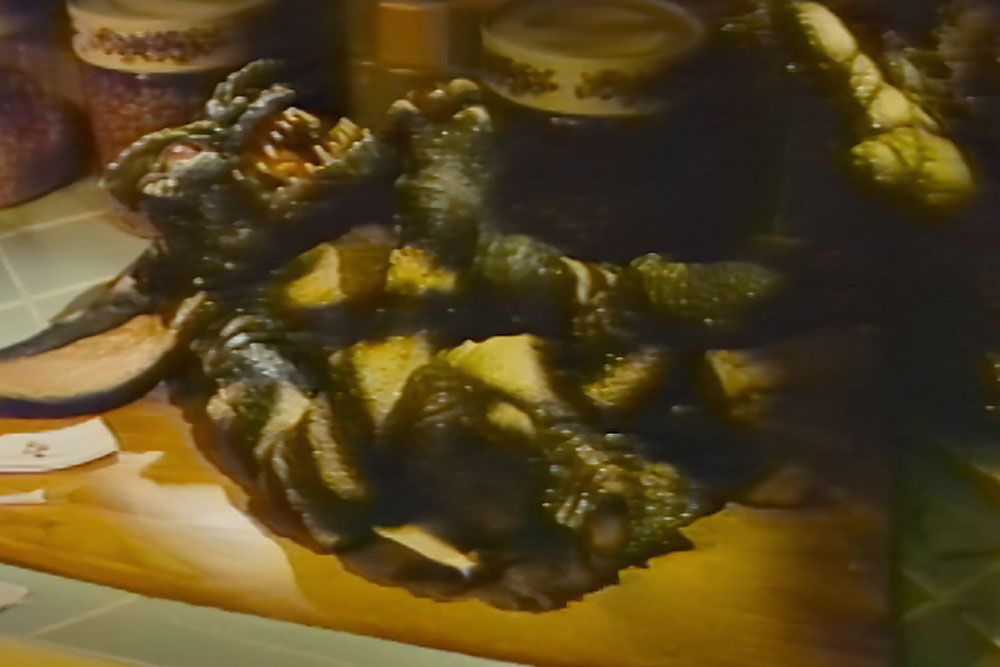
Production still of the stabbed gremlin puppet which is seen in the Gremlins Rough Cut
The first point where you notice things are being changed up a bit is the Gremlin that Lynn Peltzer knifes to death by the cabinets. In the rough cut, after Lynn Peltzer stabs the creature, the film immediately cuts to a closer shot of the Gremlin gurgling and convulsing while clutching the knife protruding from its chest, resulting in a far more agonizing death than audiences ever saw in theaters. Before the rough cut surfaced, the moment had only been hinted at through rare production stills taken on set and behind-the-scenes images from Chris Walas Inc. during development of the effect.
Finally seeing the footage in motion after decades of speculation was genuinely exciting, and it helps complete the sequence in a way fans have only imagined. In the theatrical version, the Gremlin’s death can technically still be spotted in the background of a few wide shots if you're looking for it.
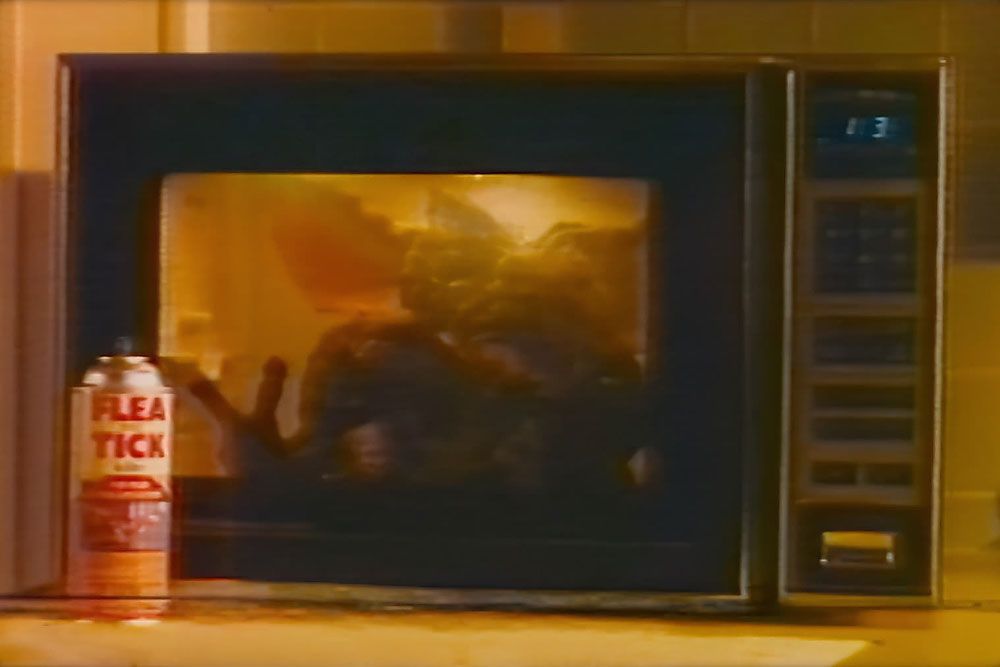
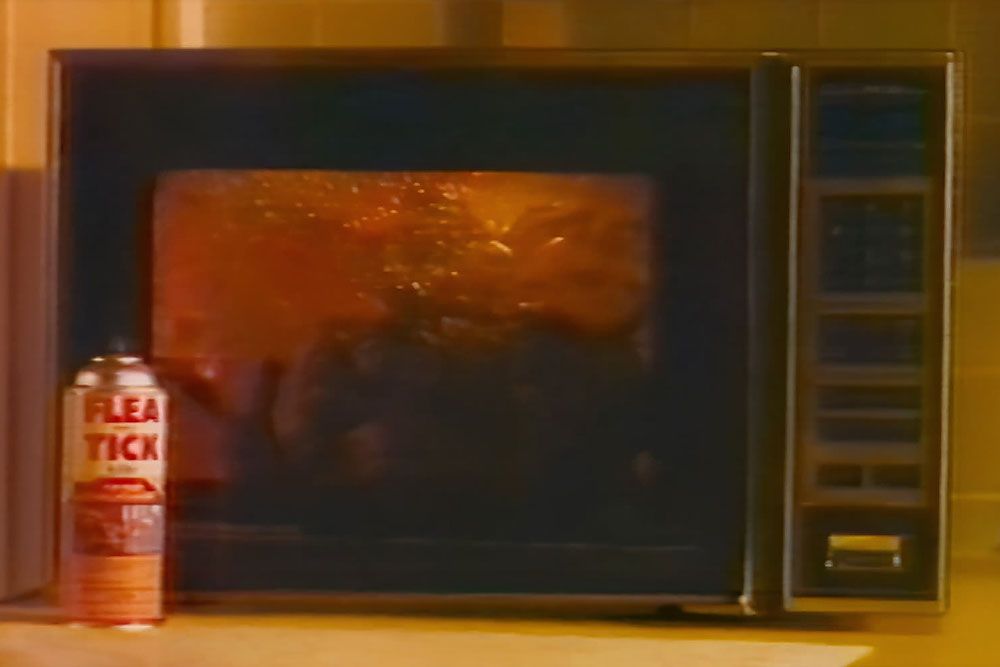
The second moment that noticeably escalated the violence is the microwave sequence. In the rough cut, the shot plays for at least twice as long as the theatrical version, lingering on the Gremlin as it is slowly cooked rather than cutting away almost immediately. The creature’s screams and movements continue far longer, making the scene feel substantially more brutal and uncomfortable. While VHS still frames can only capture so much detail, the sequence is unmistakably more graphic, more chaotic, and, in many ways, far more entertaining than the toned-down theatrical edit.
THE GREMLINS ROUGH CUT - Microwave scene
The Studio Conflict
From early in production, Warner Bros. was deeply uneasy about the film’s shifting tone—and the microwave scene became a lightning rod for that anxiety. According to director Joe Dante, the studio viewed the scene as “too ambiguous,” uncertain whether audiences were meant to laugh, recoil, or both. “The studio didn’t get it,” Dante later said. “They didn’t think it was funny.” (The Guardian, November 2017)
One of the studio’s primary concerns, echoed by some critics, was that children might imitate what they saw on screen. The image of a living creature exploding in a microwave felt dangerously provocative. In the years following the film’s release, Gremlins was often cited in debates about media violence and its influence on children, and the microwave scene in particular became emblematic of those concerns.
Dante, however, dismissed the fear as overblown. In a 2010 interview with Sight & Sound, he addressed the microwave controversy with his trademark mix of candor and sarcasm:
“I never met a kid who put his little brother in the microwave! That just didn’t happen, because kids are much smarter than adults give them credit for.”
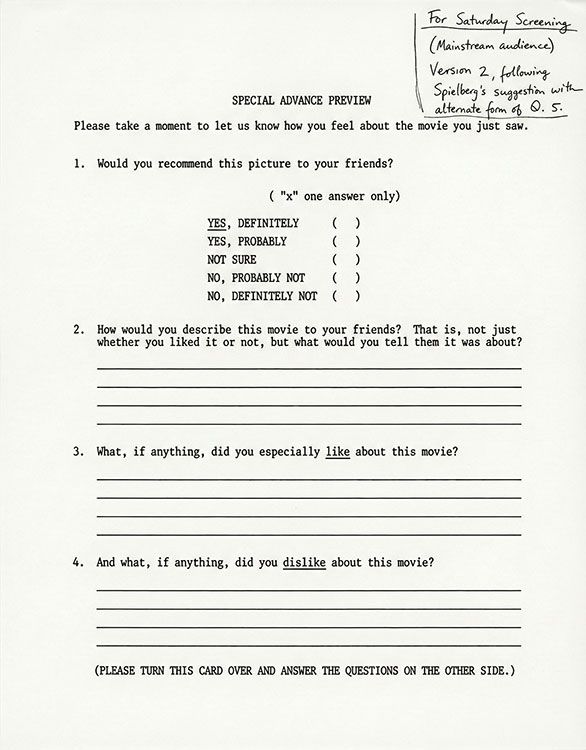
Questionnaire from the Gremlins test screening
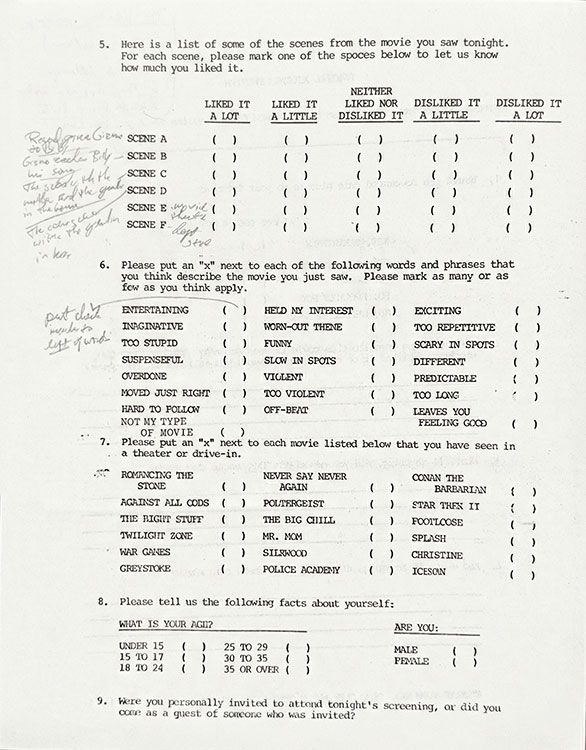
The Test Screening: A Microwaved Moment of Truth
As the first preview screening approached, tension behind the scenes was running high. Director Joe Dante, who had fought to keep the scene in despite growing studio concerns, had reason to be anxious. The film was still in post-production, and Warner Bros. was already growing increasingly uncomfortable with the tonal extremes—none more so than the kitchen sequence. A slightly more violent and literal shot of Lynn stabbing a gremlin while it grimaced in pain had already been removed at the studio’s request, replaced with an edit that softened the moment. Executives were reportedly passing notes and making quiet suggestions that the microwave gag should be toned down or cut entirely. The moment felt precarious. As the lights dimmed for the first preview screening, Dante and his team weren’t sure whether the audience would be shocked, delighted, or horrified—and whether the scene would survive to final cut at all.
No one quite knew what to expect.
And then the mixer whirred.
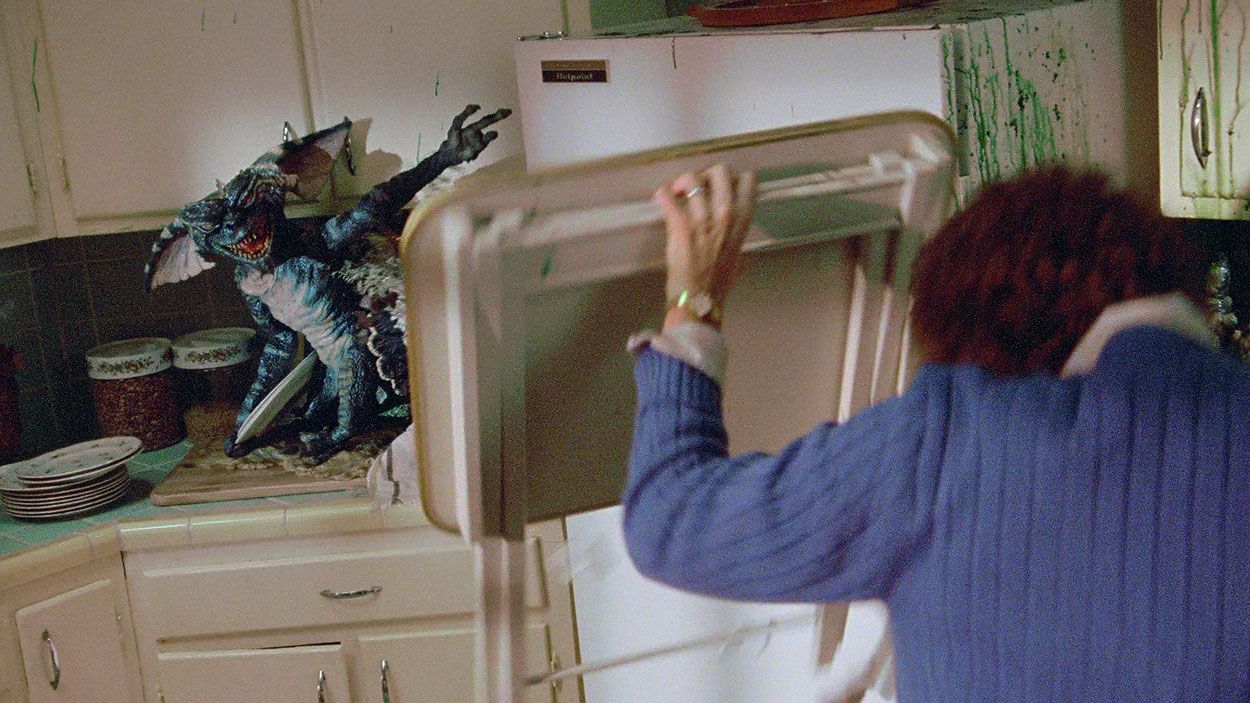
As the scene unfolded—Lynn Peltzer stabbing one gremlin, blending another into goo, and slamming the third into a microwave—the room lit up with energy. Far from recoiling in horror, the audience erupted in cheers and laughter. The shocking juxtaposition of Christmas decor, kitchen appliances, and monster gore struck a nerve.
Producer Michael Finnell recalled the precise moment he knew they had something special:
“The real moment was the scene with the mother in the kitchen with the blender and the microwave. The audience went apeshit. I turned to Joe and said, ‘You know, I think maybe we have a hit here.’” (The Ringer, June 2024)
The surprise wasn’t just that the audience accepted the scene—they relished it. The laughter wasn’t nervous or confused; it was visceral, cathartic. That exact combination was what Dante had been aiming for. He wanted to jolt the audience, not alienate them—and in that moment, it worked.
But not everyone in the theater was delighted.
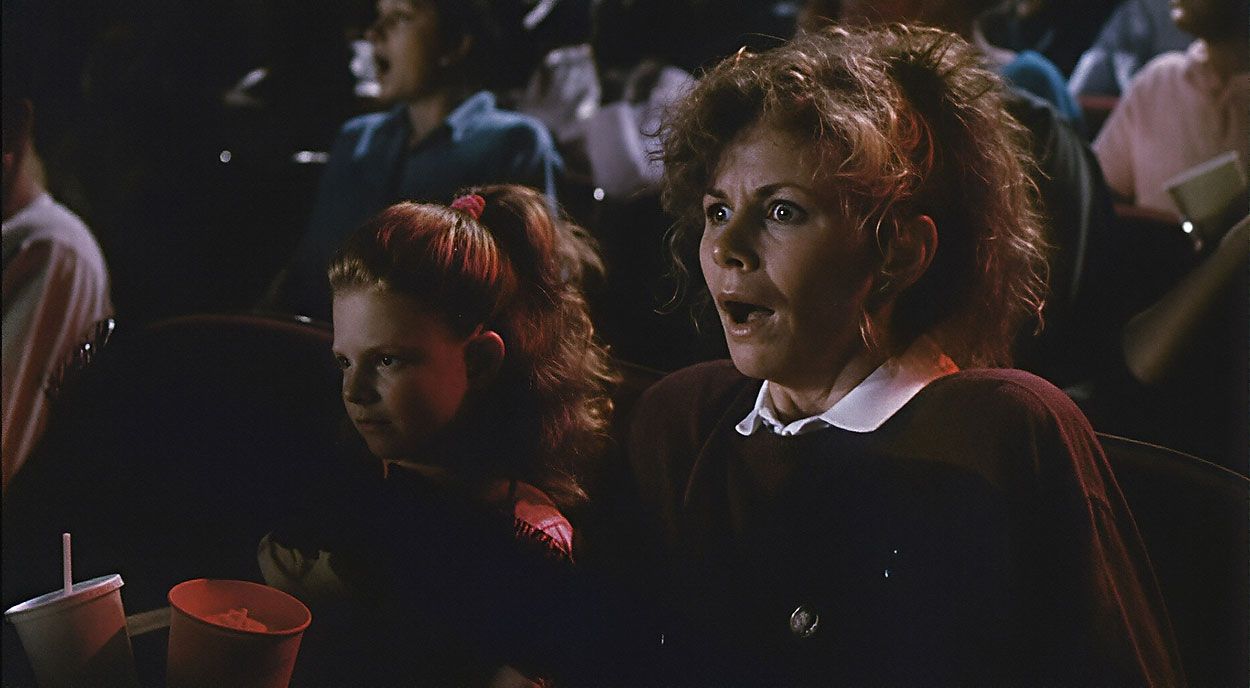
Belinda Balaski reenacting a very real moment in Gremlins 2
Joe Dante remembers a telling incident at another early screening: “I watched a woman at a screening of Gremlins. She was dragging her child out of the theater during the microwave scene and the child was screaming, ‘I don’t want to go! I don’t want to go!’” (The Ringer, June 2024) The child, in fact, broke free and ran back into the theater and hid so they could finish watching. The moment stuck with Dante, and he later parodied it in Gremlins 2: The New Batch.
The preview audience’s wild reaction to the kitchen carnage didn’t erase the studio’s concerns, but it gave Dante leverage. More importantly, it confirmed a key insight about the audience that many at the studio had missed: kids didn't just handle it, they loved it.
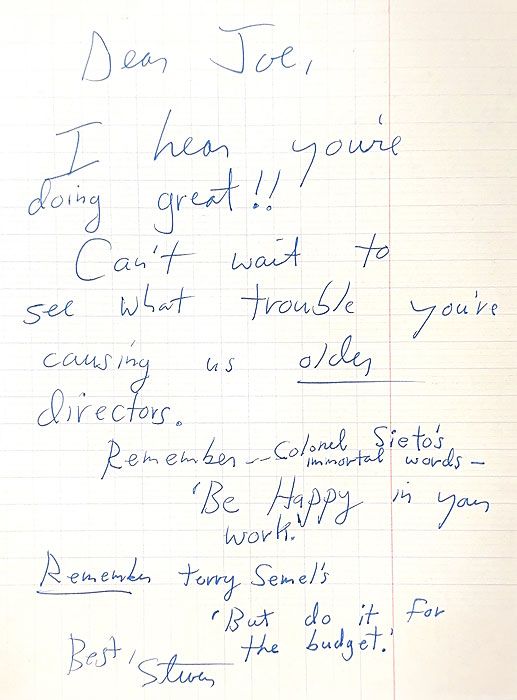
A letter to Joe Dante from Steven Spielberg during the production of Gremlins
Siskel and Ebert's 1984 review of Gremlins
Critic Reactions
When Gremlins opened in June 1984, the kitchen scene quickly became one of its most talked about—and polarizing—moments. While many audiences thrilled at the anarchic spectacle of Lynn Peltzer blending, stabbing, and microwaving her way through a pack of gremlins, others found the scene disturbing, even irresponsible.
Legendary critic (and Joe Dante friend) Leonard Maltin famously hated the film, citing its "too-vivid violence and mayhem" as a dealbreaker. He wasn't alone in his discomfort; Roger Ebert warned parents that the film was "kind of gruesome," specifically calling out the microwave scene. Ebert described the movie's tone as a "Norman Rockwell painting with blood on the turkey," a perfect encapsulation of the scene's subversive horror. Crucially, Ebert explicitly linked the scene to the urban legend of the "poodle in the microwave"—a cautionary tale that had circulated for years as a symbol of careless cruelty in the age of modern appliances.
However, not everyone was clutching their pearls. Gene Siskel championed the film for the exact same reasons others loathed it, calling it a "wickedly funny and slightly sick ride" that dared to take risks.
The controversy crossed the Atlantic, too. In the UK, the British Board of Film Classification (BBFC) was so disturbed by the kitchen scene that they slapped the movie with a 15 rating, effectively banning the very audience the movie was marketed to. Their reasoning? The violence didn't happen in a dungeon or a spaceship; it happened in a kitchen, a place accessible to every child, making the horror too "realistic" for young minds.
Though no actual incidents were ever tied to the film, the controversy added fuel to an ongoing public debate about violence in family entertainment. For some, the kitchen scene represented bold, subversive filmmaking. For others, it was a line crossed. Either way, it left a permanent mark on the cultural landscape—and on the Motion Picture Association of America, which would respond to the uproar by introducing a new rating just one month later: PG-13.
Conclusion
The microwave scene in Gremlins has since become one of the most infamous and enduring moments in 1980s cinema—a bold, goo-splattered flashpoint where horror, comedy, and suburban domesticity collided. In just a few chaotic seconds, it captured everything that made the film both beloved and controversial: its gleeful subversion of genre norms, its practical-effects bravado, and its willingness to unsettle even as it entertained. More than just a grotesque punchline, the scene helped provoke a wider industry reckoning over what “family entertainment” could get away with. Alongside the beating-heart scene in Indiana Jones and the Temple of Doom, it directly contributed to the creation of the PG-13 rating—a new middle ground between PG and R. That rating debuted just two months later with Red Dawn (1984), but its origins trace back, in part, to a gremlin in a microwave.
Four decades on, the scene remains a touchstone—not just for its audacity, but for what it revealed about shifting cultural expectations. It marked a moment when society began reassessing how children engage with media, and how films straddling genres required new ways of being categorized and understood. Rather than censoring the scene out of existence, audiences and the industry alike adapted. The MPAA changed. Viewers changed. And Gremlins, microwave and all, found its place in the evolving language of popular storytelling.
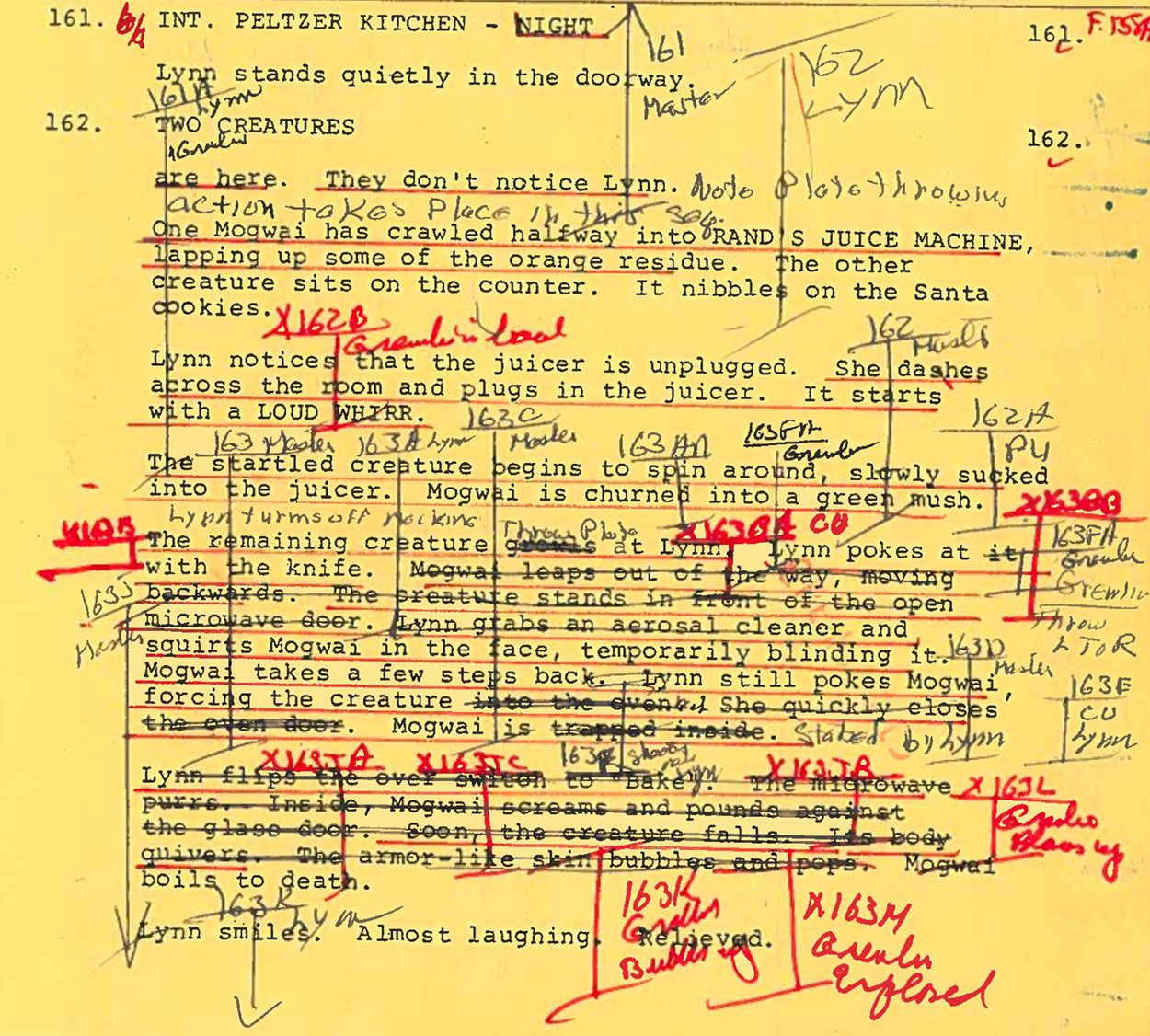
The Gremlins kitchen sequence script as it was shot
Special thanks to Howie Weed and Ralph Miller for sharing their memories for this article.